Services
Bereavement Support
We know that losing someone has a deep impact, and that everyone will react in a different way.
If you are feeling emotional, anxious, upset or worried or are having even more significant struggles with your mental health and well-being - help and support is available. As well as arranging an appointment with our in-house Mental Health Practitioner, you can access help from the following services, many of whom are available round the clock. We hope these other resources can be of use:
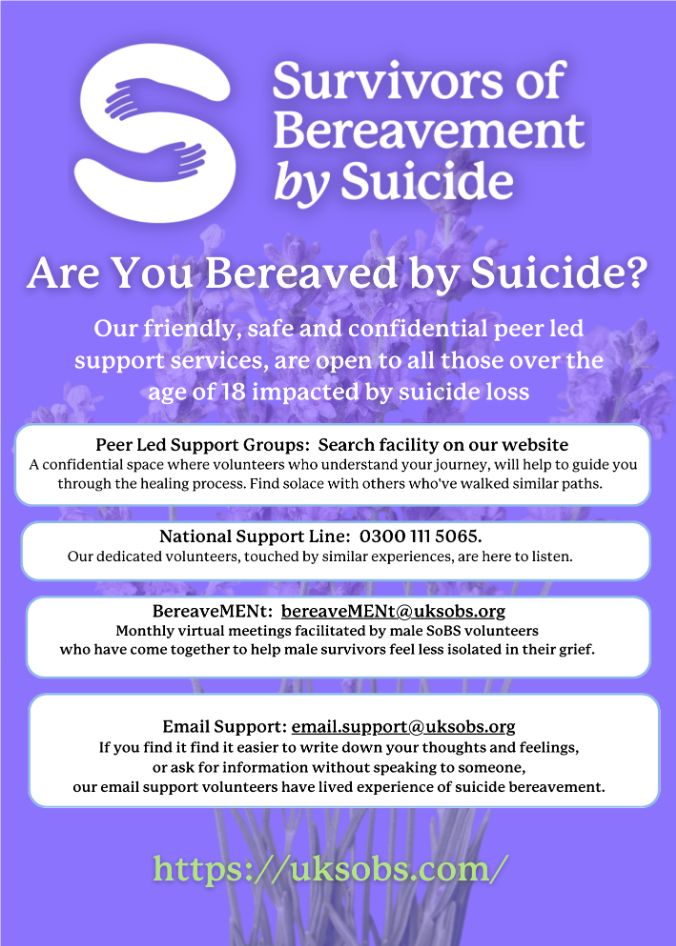
Thames Valley Suicide Bereavement Support Service (Amparo)
Provide practical and emotional support for anyone (adults, children/young people, and families) affected by suicide in the Thames Valley area. This is a confidential, free service, offering short-term or longer-term support.
Tel: 0330 088 9255
Website: https://amparo.org.uk/
South Bucks Hospice Bereavement Listening Service
We have seven Bereavement Listening Counsellors, each with the capacity to support 2 clients who have lost a loved one to a prolonged, advanced, or life limiting illness.
You may have sadly experienced bereavement in these circumstances and could benefit from this service.
Patients can Self Refer and for which there is no waiting list, contact us via email: counselling@sbhospice.org.uk
South Bucks Hospice "Navigating Life After The Storm"
This is a 6-week course (which begins in September) supporting patients who have lost a loved one to a prolonged, advanced, or life limiting illness.
The course is held at South Bucks Day Hospice on Mondays 10:30 - 12:00pm for 6 weeks and patients can Self Refer, please contact us via email: info@sbhospice.org.uk
Child Bereavement UK
Child Bereavement UK helps families to rebuild their lives when a child grieves or when a child dies. They support children and young people (up to the age of 25) when someone important to them has died or is not expected to live, and parents and the wider family when a baby or child of any age dies or is dying.
They offer free, confidential bereavement support for individuals, couples, children, young people, and families, by telephone, video or instant messenger, wherever you live in the UK. They also offer face-to-face support from a number of locations.
They welcome families and individuals of any gender or gender reassignment, marital or civil partnership status, disability, race, religion, faith, belief, or sexual orientation.
They will endeavour to source interpreters / BSL interpreters where needed / possible.
For more information click here to visit their website: https://www.childbereavementuk.org/ or call their helpline: 0800 02 888 40.
Childline
ChildLine offers free and confidential support for children and young people up to the age of 19. This is a 24/7 service.
Tel: 0800 1111
Cruse Bereavement Support
Support for all ages struggling with grief - https://www.cruse.org.uk/
Kooth
A free, safe and anonymous space for young people to find online support and counselling.
Website: https://www.kooth.com/
Organised Drug-Facilitated Sexual Assault
Organised Drug-Facilitated Sexual Assault - This hidden but serious form of abuse is a growing issue, where victims are subjected to non-consensual sexual acts while incapacitated or unconscious due to alcohol and/or drugs.
Help after rape and sexual assault
If you've been sexually assaulted it's important to remember that it was not your fault. Sexual violence is a crime, no matter who commits it or where it happens. Don't be afraid to get help.
There are services that can help if you've been sexually assaulted, raped or abused. You don't have to report the assault to the police if you don't want to. You may need time to think about what has happened to you.
But you should get medical help for any injuries and because you may be at risk of pregnancy or sexually transmitted infections (STIs). If you want the crime to be investigated, it's best to have a forensic medical examination as soon as possible.
Try not to wash or change your clothes immediately after a sexual assault. This may destroy forensic evidence that could be important if you decide to report the assault to the police (although you can still go to the police even if you have washed).
Where to get help
Sexual assault referral centres (SARCs) offer medical, practical and emotional support to anyone who has been raped, sexually assaulted or abused. SARCs have specially trained doctors, nurses and support workers to care for you.
You can get help from a SARC by booking an appointment with your nearest one.
Find your nearest sexual assault referral centre (SARC)
Other places you can get help include:
- a voluntary organisation, such as Rape Crisis, Women's Aid, Victim Support, The Survivors Trust or Male Survivors Partnership
- the 24-hour freephone National Domestic Abuse Helpline, run by Refuge, on 0808 2000 247
- the rape and sexual abuse support line run by Rape Crisis England and Wales – you can call the helpline on 0808 500 2222 or use the online chat (both are free and are open 24 hours a day, every day of the year)
- a hospital accident and emergency (A&E) department
- a genitourinary medicine (GUM) or sexual health clinic
- a contraceptive clinic
- a young people's service
- call NHS 111 or get help from 111 online
- the police, or dial 101
- in an emergency, dial 999
About sexual assault referral centres (SARCs)
Sexual assault referral centres (SARCs) are located across the country and available for everyone, regardless of gender, age, the type of incident, or when it happened.
SARCs offer a range of services, including crisis care, medical and forensic examinations and emergency contraception. They can also arrange access to an independent sexual assault advisor (ISVA), as well as referrals to mental health support and sexual violence support services.
If you are thinking about reporting an assault to the police, the centre can arrange for you to speak to a specially trained police officer who can explain the next steps.
If you decide to report the assault to the police, specially trained advisors can support you through the criminal justice system. They can also support you through the trial if the case goes to court.
Forensic medical examinations can be arranged, even if you have not decided if you want to report the assault.
It is not recommended to use a self-swab kit as this could affect the ability to get a DNA sample for evidence if you choose to report it to the police.
Having a medical examination at a SARC
It's your choice whether you’re examined or not. You can also choose to have some parts of the examination but not others.
Some people find the examination reassuring. It's a chance to check for injuries and infections and collect possible evidence.
SARCs have private rooms and specially trained doctors and nurses. You can ask for a male or female examiner and choose who is in the room with you.
A doctor or nurse will ask you health questions, for example about the assault or recent sexual activity. If you choose, they can collect swabs and other samples. They can also document any injuries that can be used as evidence.
They will explain what they've found and discuss with you your options. They will also offer you any treatment, such as emergency contraception or protection from certain STIs.
In most SARCs you can have a shower before you leave, if you want to.
NHS video about what happens at a SARC (YouTube)
Page created: 13 October 2020